Wednesday, April 11, 2012

Cartography Analysis

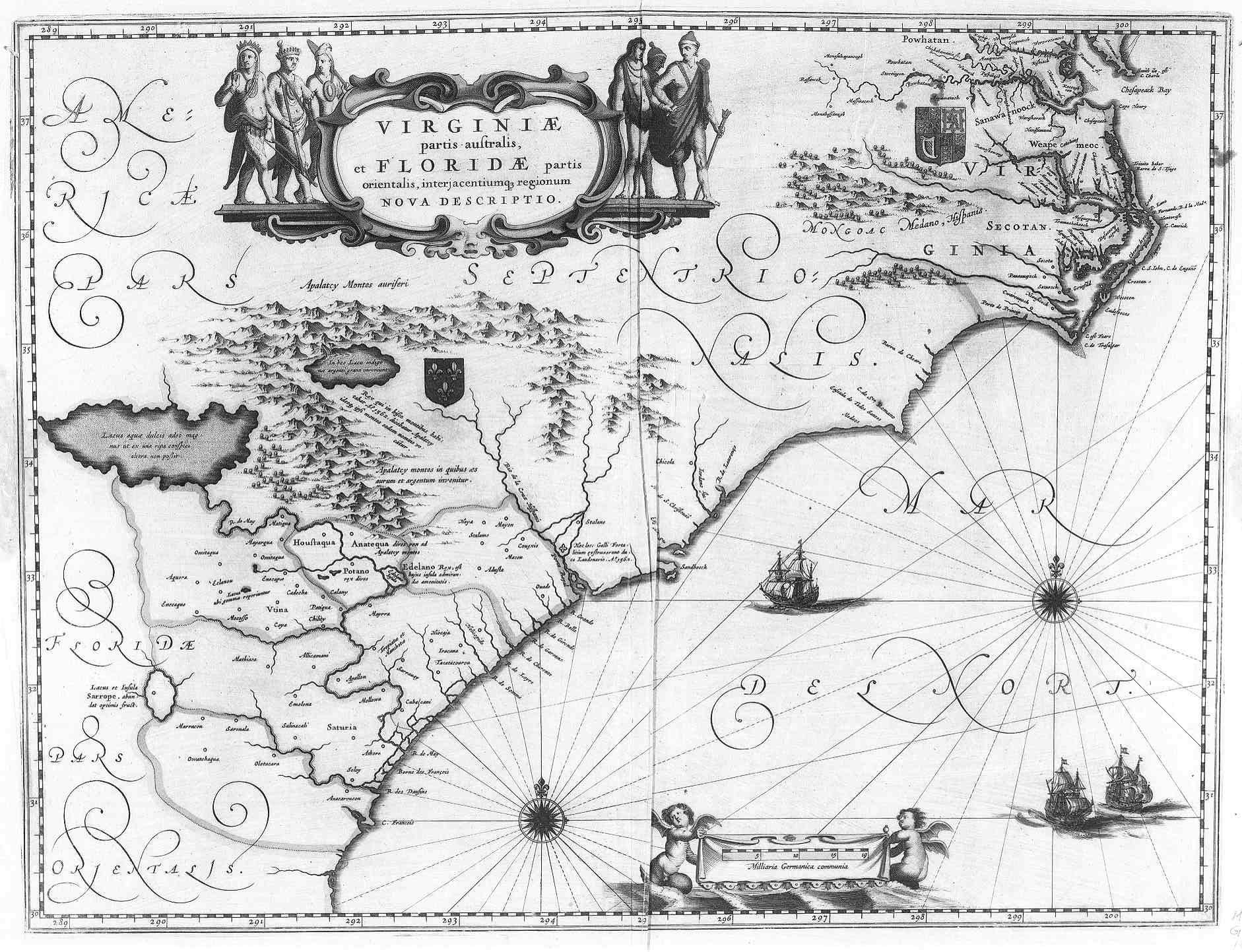
http://www.libs.uga.edu/darchive/hargrett/maps/1640b55.jpg
This map is unique in that it's written in Latin. It's quite possible that this is because the map is from the Catholic Church, and they predominately use Latin. Other evidence suggesting that this map may be from the Church is in the details of the pictures. On the bottom of the map surrounding the mileage scale are two demons. They appear as children with bat wings and fish scales along their legs and arms. This may symbolize the dangers and threats that lurk at sea.

There is also evidence that this map may originate in England. The English are the first European explorers to settle Virginia, so they would naturally create detailed maps around that area. There are also English Royalty symbols (such as the three spade-shaped spear heads) found within the two banners located on the land regions.

Another significant detail is the drawing of the natives surrounding the map's title. They appear more primitive with being scantly clothed, displaying their "savage" and "primitive" features. This only reinforces the stereotype of that time period: that the Natives are inferior to the white Europeans. This is also displayed in how the map labels the European settlements and Native American tribal regions. The European towns are written orderly and uniformity with each settlement's name running parallel. On the other hand, the Native American regions are written like geographical features. The names of tribes are stretched or twisted to fit the general land with which they occupy. This contributes to the sense of inferiority while giving the vibe that their land is there to be conquered like any other land. As Valerie Babb writes, "...a growing sense of European entitlement to the Americas is evident..." (page 50).

Tuesday, November 1, 2011

op ed.

My op-ed piece is Steve Job's Sister, Mona Simpson, giving an eulogy for Steve Job. She didn't know that her long-lost brother was Steve Jobs--she met up with him when she was 25, and they became close friends since. She wrote about how he lived virtuously, humbly, and determinedly, and explained how these traits never disappeared even through his sickness. The article transitions to how his death was like, ending with his own last words: "OH WOW! OH WOW! OH WOW!"

The article was very effective. It convinced the readers how Steve Jobs was not a self-centered CEO stereotype. Using touching stories, Simpson strengthened her argument with pathos. It gave a feel of an insider's relation with Steve Jobs. The chronological order of events in the also allowed the article to smoothly transition to how he was when he was healthy, ill, and eventually dead. This piece of writing was clearly effective in showing how great Steve Jobs was beyond the Apple Company.

haphephobia

It's the fear of touching or being touched by people. It feels like my life depends on my personal bubble not rupturing. Handshakes are absolutely dreadful. The "brief" moment where my palm touches another man's palm burns in agony. Any mind reader would recoil from the deafening scream inside my head from the irrational panic that overtakes me. A pat on the back becomes a baseball bat blow, causing cold sweats and convulsions that linger after the incident.

It feels pathetic. Why should such an insignificant touch affect me so? It takes such effort to suppress the noticeable results when someone happens to touch me. I've been able to control compulsive shouts of, "Don't touch me!" whenever someone oblivious to this fear steps over the line. Progress has been made: I sometimes accept hugs or hand them out to friends who truly need it (although I never touch them with my hands, just forearms). But anything unexpected can cause pure dread: my delicate personal bubble does contain my life.

Growing my Essays

I stumble a small idea seed, either left behind from a piece of literature, a teacher, or my curiosity. It's a small seed, but I reach out to grasp it. It's sometimes a long distance between here and a safe location to plant the seed, and I pray I don't lose it.

At my desk, on my bed, or in front of a computer, I take that minuscule seed and nurture it to grow. Pencil or pens, paper or keyboard, all can germinate that seed. More thought, effort, and patience grow the idea into a work of writing. A little pruning or a little fertilizer strengthen the paragraphs and sentences that branch from the main body until it sprouts a fruiting body. I take the fruit of my work to the kitchen for final preparations. A little spice and a low simmer later, others are ready to indulge on my idea.

Tuesday, September 6, 2011

Presidential Inauguration Word Cloud: "Peace" and "War"

New York Times compiled here a word cloud for the presidential inauguration speeches where the size of the word correlates to it's frequency in the speech. One thing that jumped out on me was the use of the words "peace" and "war" during major war times.

In America's early years, the word "war" was used significantly more than "peace." For example: preceding the war of 1812, James Madison said "war" over twice as much as any other word during his second term's inauguration speech. The same thing happened during Abraham Lincoln's speech in 1865 after the American Civil War.

It wasn't until 1901, after the Spanish-American War, that the words "peace" began showing up more during the president's speeches. In William McKinley's speech, "peace" and "war" appeared seven times each. The last time "war" was spoken excessively was in Warren Harding's speech in 1921, two years after World War I ended.

The first time the word "peace" began appearing more in presidential inaugurations was Woodrow Wilson's 1917 speech. It makes sense, especially since he didn't want America to get involved in the war. Franklin Roosevelt's 1945 speech was similar, where "peace" became his most used word.

After World War II ended "peace" became commonplace in the president's speeches. It makes sense, especially since that period was the Cold War. Interestingly, "peace" was used excessively during Dwight Eisenhower's and Richard Nixon's speeches, which took place during the Korean and Vietnam wars. The use of the word "war" was a combined 13 times versus 53 times for peace. During the climatic part of the Cold war, Ronald Reagan's ratio came to a whopping 2 for "war," 21 for "peace."

Since the War on Terror, the frequency of both words declined. The presidents spoke "war" about twice per speech. Although the word "peace" frequency dropped tremendously, it went under the cloak of "freedom" and "liberty" during George W. Bush's inauguration in 2005. Unlike most war-time speeches, Barack Obama's 2009 speech didn't hover around war/peace-related words.

Wednesday, August 31, 2011

Animal, Vegetable, Miracle Must Read!

The non-fiction book I read was Animal, Vegetable, Miracle, by Barbara Kingsolver. It follows their challenge to eat "locavore" style for a year--eating only foods that are grown locally, not shipped halfway around the country or world. With their small farm property in the Appalachians, the family of four managed to sustain themselves from spring to spring through gardening, tending their flock of chickens and turkeys, and buying from the local farmer's market. It's not a story of, "Do they make it," but rather, "HOW do they make it?"

The book caught my interest right away since I myself am an avid gardener. Although it's difficult to grow vegetables in my yard; about 90% of it is shaded by our elderly oaks and ashes. I could easily relate to Barbara's labor of love to manually de-weed between the thorny pumpkin and cucumber leaves, plucking those nasty finger-sized hornworms off of the tomato plants, canning the 54lbs of strawberries and 86 ears of corn, saving seeds, and the pure satisfaction that the taste indeed is richer than the watered-down lumps of plant matter found in supermarkets today.

I feel like the book did it's intended purpose: get me aware about where my food comes from and what it went through to reach me. I've pondered about the ethical issues surrounding both the meat and produce industry more than usual. Right now I feel like if I was given the choice, I'd go the extra mile to get organically grown produce to help the workers, soil, and ecosystem from the damaging conventional means of farming, especially if it was local.

Overall, this book is worth reading no matter your location on the reading spectrum. Both casual readers and inspiration-seeking readers can enjoy the story.

Tuesday, August 30, 2011

How the Internet Affects Our Mind's Mechanics

Nicholas Carr points out a startling phenomenon among internet users: people are beginning to have troubles concentrating on lengthier articles. All of the instantaneous access to information is changing the way our mind functions. As Maryanne Wolf puts it, we're changing "how" we read by changing "what" we read thanks to the plasticity of our brain.

What begins to worry me is what lies in the future of mankind. Google is doing to it's users what Frederick Taylor did to his employees--"systematize everything" to the point of maximum efficiency. When the article explained Google's aspirations for artificial intelligence, I began to wonder what benefits this brings to us as a species. It's hard to explain what the purpose of our existence is, but I believe it goes along the lines of enjoying life to it's fullest potential and to apply ourselves to the better of the world, not just civilization.

Our minds are vast, complex mechanisms. We can do more than retain knowledge; we can apply different concepts in different ways to create something new and original. We can feel satisfaction after applying ourselves and uncovering a different truth to ponder. An artificial intelligence (thus far) would have difficulty doing all of that. We should put forth the extra effort to not fall into the trap of "instant gratification" easy access to knowledge provides.

I find it funny that the general internet culture has implemented the "tl;dr" (which stands for "too long; didn't read") at the end of long posts.

tl;dr: you're just another statistic if you only read this!